Get Free Ebook basketball game stats book: Large Size (8" X 10"), 164 Pages (82 Games), Log The Best Player You Love (Volume 8), by Mike Murphy SportRecorder Express
This is among your preferred books, right? That's true. If this is one of them, you can start by reviewing web page by page for this book. The reasons could not be so complex. We provide you a good publication that will certainly not just inspire you however likewise show you real life. When getting this publication to read, it will certainly be so different when you read others. This is a brand-new coming publication that makes this world so shacked. For the sake of your life, you could obtain many options as well as benefits form this Basketball Game Stats Book: Large Size (8" X 10"), 164 Pages (82 Games), Log The Best Player You Love (Volume 8), By Mike Murphy SportRecorder Express

basketball game stats book: Large Size (8" X 10"), 164 Pages (82 Games), Log The Best Player You Love (Volume 8), by Mike Murphy SportRecorder Express

Get Free Ebook basketball game stats book: Large Size (8" X 10"), 164 Pages (82 Games), Log The Best Player You Love (Volume 8), by Mike Murphy SportRecorder Express
Find your own ways to fulfil your leisure time. Thinking about reviewing a publication as one of the tasks to do in leisure may be proper. Reading a book is priceless and also it will worry about the new things. Checking out, as considered as the uninteresting activity, may not rally be as exactly what you think of. Yeah, analysis can be enjoyable, reading can be satisfying, as well as analysis will certainly give you new points, more things.
This publication is really appropriate for guide style that you are seeking currently. Many resources may supply the selection, but Basketball Game Stats Book: Large Size (8" X 10"), 164 Pages (82 Games), Log The Best Player You Love (Volume 8), By Mike Murphy SportRecorder Express can be the best means. It is not just one point that you could delight in. Extra things as well as lessons are provided or you to cover exactly what you precisely require. Lots of viewers have to read guides likewise due to the particular reasons. Some could love to review it a lot however some may need it because the work target date.
Obtaining the contended material of guide even in the soft file is truly amazing. You could see exactly how the Basketball Game Stats Book: Large Size (8" X 10"), 164 Pages (82 Games), Log The Best Player You Love (Volume 8), By Mike Murphy SportRecorder Express exists. Before you obtain guide, you might unknown about just what guide is. Yet, for even more viable thing, we will share you bit concerning this book. This is the book to advise that gives you a good thing to do. It is also offered in very fascinating reference, example, and also explanation.
Make this publication as favourite publication to check out currently. There is no far better publication with the very same subject as this one. You could see just how the words that are created are really compatible to urge your condition making better. Now, you can additionally really feel that things of Basketball Game Stats Book: Large Size (8" X 10"), 164 Pages (82 Games), Log The Best Player You Love (Volume 8), By Mike Murphy SportRecorder Express are proffered not just for making good possibilities for the readers however also provide excellent environment for the result of just what to write.
Product details
Series: basketball game stats book (Book 8)
Paperback: 164 pages
Publisher: CreateSpace Independent Publishing Platform (February 27, 2018)
Language: English
ISBN-10: 1986023648
ISBN-13: 978-1986023641
Product Dimensions:
8 x 0.4 x 10 inches
Shipping Weight: 15.2 ounces (View shipping rates and policies)
Average Customer Review:
Be the first to review this item
Amazon Best Sellers Rank:
#334,343 in Books (See Top 100 in Books)
basketball game stats book: Large Size (8" X 10"), 164 Pages (82 Games), Log The Best Player You Love (Volume 8), by Mike Murphy SportRecorder Express PDF
basketball game stats book: Large Size (8" X 10"), 164 Pages (82 Games), Log The Best Player You Love (Volume 8), by Mike Murphy SportRecorder Express EPub
basketball game stats book: Large Size (8" X 10"), 164 Pages (82 Games), Log The Best Player You Love (Volume 8), by Mike Murphy SportRecorder Express Doc
basketball game stats book: Large Size (8" X 10"), 164 Pages (82 Games), Log The Best Player You Love (Volume 8), by Mike Murphy SportRecorder Express iBooks
basketball game stats book: Large Size (8" X 10"), 164 Pages (82 Games), Log The Best Player You Love (Volume 8), by Mike Murphy SportRecorder Express rtf
basketball game stats book: Large Size (8" X 10"), 164 Pages (82 Games), Log The Best Player You Love (Volume 8), by Mike Murphy SportRecorder Express Mobipocket
basketball game stats book: Large Size (8" X 10"), 164 Pages (82 Games), Log The Best Player You Love (Volume 8), by Mike Murphy SportRecorder Express Kindle
basketball game stats book: Large Size (8" X 10"), 164 Pages (82 Games), Log The Best Player You Love (Volume 8), by Mike Murphy SportRecorder Express PDF
basketball game stats book: Large Size (8" X 10"), 164 Pages (82 Games), Log The Best Player You Love (Volume 8), by Mike Murphy SportRecorder Express PDF
basketball game stats book: Large Size (8" X 10"), 164 Pages (82 Games), Log The Best Player You Love (Volume 8), by Mike Murphy SportRecorder Express PDF
basketball game stats book: Large Size (8" X 10"), 164 Pages (82 Games), Log The Best Player You Love (Volume 8), by Mike Murphy SportRecorder Express PDF

Ebook Free Socratic Logic: A Logic Text using Socratic Method, Platonic Questions, and Aristotelian Principles, Edition 3.1
Checking out Socratic Logic: A Logic Text Using Socratic Method, Platonic Questions, And Aristotelian Principles, Edition 3.1 will offer a lot more advantages that could generally on the others or might not be discovered in others. A publication turns into one that is very important in holding the rule in this life. Schedule will certainly offer as well as attach you regarding exactly what you require and satisfy. Schedule will also educate you concerning exactly what you recognize or exactly what you have actually not known yet really.
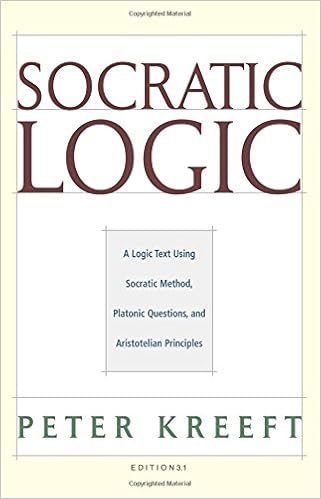
Socratic Logic: A Logic Text using Socratic Method, Platonic Questions, and Aristotelian Principles, Edition 3.1

Ebook Free Socratic Logic: A Logic Text using Socratic Method, Platonic Questions, and Aristotelian Principles, Edition 3.1
No surprise you activities are, reviewing will certainly be constantly required. It is not only to satisfy the obligations that you should complete in deadline time. Reviewing will certainly motivate your mind as well as ideas. Certainly, reading will considerably develop your experiences about whatever. Checking out Socratic Logic: A Logic Text Using Socratic Method, Platonic Questions, And Aristotelian Principles, Edition 3.1 is additionally a way as one of the cumulative publications that provides many benefits. The benefits are not only for you, however, for the other individuals with those meaningful benefits.
Reading is except other people who obligate or order you to review. The one that could delight in and make use of the advantages of reading is you. So, it is not type of even worse when you are attempting to be much better by analysis. Even reading will not lead you to be successful 100%; in this manner can assist you to fulfil the problem, lesson, experience, and expertise. Furthermore, this publication qualified Socratic Logic: A Logic Text Using Socratic Method, Platonic Questions, And Aristotelian Principles, Edition 3.1 also turns into one that is actually preferred.
This book is actually conceived to offer not just the recent life yet likewise future. By supplying the benefits of this Socratic Logic: A Logic Text Using Socratic Method, Platonic Questions, And Aristotelian Principles, Edition 3.1, maybe it will certainly lead you to not be question of it. Be among the great readers in the world that always check out the premium quality book. With the qualified books, you can develop your mind as well as thought. This is not only concerning the opinion; it's everything about the truth.
Because of this, you can take Socratic Logic: A Logic Text Using Socratic Method, Platonic Questions, And Aristotelian Principles, Edition 3.1 as one of your analysis products today. Even you still have the various other book; you can create your readiness to actually get this meaningful publication. It will always provide benefits from some sides. Reading this sort of book also will guide you to have more experiences that have not.
Excerpt. © Reprinted by permission. All rights reserved.
An excerpt from chapter 1:Section 3. The two logics (P)(This section can be omitted without losing anything you will need later on in the book. It’s here both to satisfy the advanced student’s curiosity and to sell the approach of this book to prospective teachers who may question its emphasis on Aristotelian rather than symbolic logic, by justifying this choice philosophically.) Almost four hundred years before Christ, Aristotle wrote the world’s first logic textbook. Actually it was six short books, which collectively came to be known as the Organon, or “instrument.” From then until 1913, when Bertrand Russell and Alfred North Whitehead published Principia Mathematica, the first classic of mathematical or symbolic logic, all students learned Aristotelian logic, the logic taught in this book. The only other “new logic” for twenty-four centuries was an improvement on the principles of inductive logic by Francis Bacon’s Novum Organum (“New Or-ganon”), in the 17th century, and another by John Stuart Mill, in the 19th century. (Inductive reasoning could be very roughly and inadequately defined as reasoning from concrete particular instances, known by experience, while deduction reasons from general principles. Induction yields only probability, while deduction yields certainty. “Socrates, Plato and Aristotle are mortal, therefore probably all men are mortal” is an example of inductive reasoning; “All men are mortal, and Socrates is a man, therefore Socrates is mortal” is an example of deductive reasoning.) Today nearly all logic textbooks use the new mathematical, or symbolic, logic as a kind of new language system for deductive logic. (It is not a new logic; logical principles are unchangeable, like the principles of algebra. It is more like changing from Roman numerals to Arabic numerals.) There are at least three reasons for this change: (1) The first and most important one is that the new logic really is superior to the old in efficiency for expressing many long and complex arguments, as Arabic numerals are to Roman numerals, or a digital computer to an analog computer, or writing in shorthand to writing in longhand. However, longhand is superior to shorthand in other ways: e.g. it has more beauty and elegance, it is intelligible to more people, and it gives a more personal touch. That is why most people prefer longhand most of the time – as most beginners prefer simpler computers (or even pens). It is somewhat similar in logic: most people “argue in longhand,” i.e. ordinary language; and Aristotelian logic stays close to ordinary language. That is why Aristotelian logic is more practical for beginners. Even though symbolic language is superior in sophistication, it depends on commonsense logic as its foundation and root. Thus you will have a firmer foundation for all advanced logics if you first master this most basic logic. Strong roots are the key to healthy branches and leaves for any tree. Any farmer knows that the way to get better fruit is to tend the roots, not the fruits. (This is only an analogy. Analogies do not prove anything – that is a common fallacy – they only illuminate and illustrate. But it is an illuminating analogy.) Modern symbolic logic is mathematical logic. “Modern symbolic logic has been developed primarily by mathematicians with mathematical applications in mind.” This from one of its defenders, not one of its critics (Henry C. Bayerly, in A Primer of Logic. N.Y.: Harper & Row, 1973, p.4). Mathematics is a wonderful invention for saving time and empowering science, but it is not very useful in most ordinary conversations, especially philosophical conversations. The more important the subject matter, the less relevant mathematics seems. Its forte is quantity, not quality. Mathematics is the only totally clear, utterly unambiguous language in the world; yet it cannot say anything very interesting about anything very important. Compare the exercises in a symbolic logic text with those in this text. How many are taken from the Great Books? How many are from conversations you could have had in real life? (2) A second reason for the popularity of symbolic logic is probably its more scientific and exact form. The very artificiality of its language is a plus for its defenders. But it is a minus for ordinary people. In fact, Ludwig Wittgenstein, probably the most influential philosophical logician of the 20th century, admitted, in Philosophical Investigations, that “because of the basic differences between natural and artificial languages, often such translations [between natural-language sentences and artificial symbolic language] are not even possible in principle.” “Many logicians now agree that the methods of symbolic logic are of little practical usefulness in dealing with much reasoning encountered in real-life situations” (Stephen N. Thomas, Practical Reasoning in Natural Language, Prentice-Hall, 1973). – And in philosophy! “However helpful symbolic logic may be as a tool of the . . . sciences, it is [relatively] useless as a tool of philosophy. Philosophy aims at insight into principles and into the relationship of conclusions to the principles from which they are derived. Symbolic logic, however, does not aim at giving such insight” (Andrew Bachhuber, Introduction to Logic (New York: Appleton-Century Crofts, 1957), p. 318). (3) But there is a third reason for the popularity of symbolic logic among philosophers, which is more substantial, for it involves a very important difference in philosophical belief. The old, Aristotelian logic was often scorned by 20th century philosophers because it rests on two commonsensical but unfashionable philosophical presuppositions. The technical names for them are “epistemological realism” and “metaphysical realism.” These two positions were held by the vast majority of all philosophers for over 2000 years (roughly, from Socrates to the 18th century) and are still held by most ordinary people today, since they seem so commonsensical, but they were not held by many of the influential philosophers of the past three centuries. (The following summary should not scare off beginners; it is much more abstract and theoretical than most of the rest of this book.) The first of these two presuppositions, “epistemological realism,” is the belief that the object of human reason, when reason is working naturally and rightly, is objective reality as it really is; that human reason can know objective reality, and can sometimes know it with certainty; that when we say “two apples plus two apples must always be four apples,” or that “apples grow on trees,” we are saying something true about the universe, not just about how we think or about how we choose to use symbols and words. Today many philosophers are skeptical of this belief, and call it naïve, largely because of two 18th century “Enlightenment” philosophers, Hume and Kant. Hume inherited from his predecessor Locke the fatal assumption that the immediate object of human knowledge is our own ideas rather than objective reality. Locke naïvely assumed that we could know that these ideas “corresponded” to objective reality, somewhat like photographs; but it is difficult to see how we can be sure any photograph accurately corresponds to the real object of which it is a photograph if the only things we can ever know directly are photographs and not real objects. Hume drew the logical conclusion of skepticism from Locke’s premise. Once he limited the objects of knowledge to our own ideas, Hume then distinguished two kinds of propositions expressing these ideas: what he called “matters of fact” and “relations of ideas.” What Hume called “relations of ideas” are essentially what Kant later called “analytic propositions” and what logicians now call “tautologies”: propositions that are true by definition, true only because their predicate merely repeats all or part of their subject (e.g. “Trees are trees” or “Unicorns are not non-unicorns” or “Unmarried men are men”). What Hume called “matters of fact” are essentially what Kant called “synthetic propositions,” propositions whose predicate adds some new information to the subject (like “No Englishman is 25 feet tall” or “Some trees never shed their leaves”); and these “matters of fact,” according to Hume, could be known only by sense observation. Thus they were always particular (e.g. “These two men are bald”) rather than universal (e.g. “All men are mortal”), for we do not sense universals (like “all men”), only particulars (like “these two men”). Common sense says that we can be certain of some universal truths, e.g., that all men are mortal, and therefore that Socrates is mortal because he is a man. But according to Hume we cannot be certain of universal truths like “all men are mortal” because the only way we can come to know them is by generalizing from particular sense experiences (this man is mortal, and that man is mortal, etc.); and we cannot sense all men, only some, so our generalization can only be probable. Hume argued that particular facts deduced from these only-probable general principles could never be known or predicted with certainty. If it is only probably true that all men are mortal, then it is only probably true that Socrates is mortal. The fact that we have seen the sun rise millions of times does not prove that it will necessarily rise tomorrow. Hume’s “bottom line” conclusion from this analysis is skepticism: there is no certain knowledge of objective reality (“matters of fact”), only of our own ideas (“relations of ideas”). We have only probable knowledge of objective reality. Even scientific knowledge, Hume thought, was only probable, not certain, because science assumes the principle of causality, and this principle, according to Hume, is only a subjective association of ideas in our minds. Because we have seen a “constant conjunction” of birds and eggs, because we have seen eggs follow birds so often, we naturally assume that the bird is the cause of the egg. But we do not see causality itself, the causal relation itself between the bird and the egg. And we certainly do not see (with our eyes) the universal “principle of causality.” So Hume concluded that we do not really have the knowledge of objective reality that we naturally think we have. We must be skeptics, if we are only Humean beings. Kant accepted most of Hume’s analysis but said, in effect, “I Kant accept your skeptical conclusion.” He avoided this conclusion by claiming that human knowledge does not fail to do its job because its job is not to conform to objective reality (or “things-in-themselves,” as he called it), i.e. to correspond to it or copy it. Rather, knowledge constructs or forms reality as an artist constructs or forms a work of art. The knowing subject determines the known object rather than vice versa. Human knowledge does its job very well, but its job is not to learn what is, but to make what is, to form it and structure it and impose meanings on it. (Kant distinguished three such levels of imposed meanings: the two “forms of apperception”: time and space; twelve abstract logical “categories” such as causality, necessity, and relation; and the three “ideas of pure reason”: God, self, and world.) Thus the world of experience is formed by our knowing it rather than our knowledge being formed by the world. Kant called this idea his “Copernican Revolution in philosophy.” It is sometimes called “epistemological idealism” or “Kantian idealism,” to distinguish it from epistemological realism. (“Epistemology” is that division of philosophy which studies human knowing. The term “epistemological idealism” is sometimes is used in a different way, to mean the belief that ideas rather than objective reality are the objects of our knowledge; in that sense, Locke and Hume are epistemological idealists too. But if we use “epistemological idealism” to mean the belief that the human idea (or knowing, or consciousness) determines its object rather than being determined by it, then Kant is the first epistemological idealist.) The “bottom line” for logic is that if you agree with either Hume or Kant, logic becomes the mere manipulation of our symbols, not the principles for a true orderly knowledge of an ordered world. For instance, according to epistemological idealism, general “categories” like “relation” or “quality” or “cause” or “time” are only mental classifications we make, not real features of the world that we discover. In such a logic, “genus” and “species” mean something very different than in Aristotelian logic: they mean only any larger class and smaller sub-class that we mentally construct. But for Aristotle a “genus” is the general or common part of a thing’s real essential nature (e.g. “animal” is man’s genus), and a “species” is the whole essence (e.g. “rational animal” is man’s species). (See Chapter III, Sections 2 and 3.) Another place where modern symbolic logic merely manipulates mental symbols while traditional Aristotelian logic expresses insight into objective reality is the interpretation of a conditional (or “hypothetical”) proposition such as “If it rains, I will get wet.” Aristotelian logic, like common sense, interprets this proposition as an insight into real causality: the rain causes me to get wet. I am predicting the effect from the cause. But symbolic logic does not allow this commonsensical, realistic interpretation. It is skeptical of the “naïve” assumption of epistemological realism, that we can know real things like real causality; and this produces the radically anti-commonsensical (or, as they say so euphemistically, “counter-intuitive”) “problem of material implication” (see page 23). Besides epistemological realism, Aristotelian logic also implicitly assumes metaphysical realism. (Metaphysics is that division of philosophy which investigates what reality is; epistemology is that division of philosophy which investigates what knowing is.) Epistemological realism contends that the object of intelligence is reality. Metaphysical realism contends that reality is intelligible; that it includes a real order; that when we say “man is a rational animal,” e.g., we are not imposing an order on a reality that is really random or chaotic or unknowable; that we are expressing our discovery of order, not our creation of order; that “categories” like “man” or “animal” or “thing” or “attribute” are taken from reality into our language and thought, not imposed on reality from our language and thought. Metaphysical realism naturally goes with epistemological realism. Technically, metaphysical realism is the belief that universal concepts correspond to reality; that things really have common natures; that “universals” such as “human nature” are real and that we can know them. There are two forms of metaphysical realism: Plato thought that these universals were real things in themselves, while Aristotle thought, more commonsensically, that they were real aspects of things which we mentally abstracted from things. (See Chapter II, Section 3, “The Problem of Universals.”) The opposite of realism is “nominalism,” the belief that universals are only man-made nomini (names). William of Ockham (1285–1349) is the philosopher who is usually credited (or debited) with being the founder of nominalism. Aristotelian logic assumes both epistemological realism and metaphysical realism because it begins with the “first act of the mind,” the act of understanding a universal, or a nature, or an essence (such as the nature of “apple” or “man”). These universals, or essences, are known by concepts and expressed by what logic calls “terms.” Then two of these universal terms are related as subjects and predicates of propositions (e.g. “Apples are fruits,” or “Man is mortal”). “Aristotle never intended his logic to be a merely formal calculus [like mathematics]. He tied logic to his ontology [metaphysics]: thinking in concepts presupposes that the world is formed of stable species” (J. Lenoble, La notion de l’experience, Paris, 1930, p. 35). Symbolic logic is a set of symbols and rules for manipulating them, without needing to know their meaning and content, or their relationship to the real world, their “truth” in the traditional, commonsensical sense of “truth.” A computer can do symbolic logic. It is quantitative (digital), not qualitative. It is reducible to mathematics. The new logic is sometimes called “propositional logic” as well as “mathematical logic” or “symbolic logic” because it begins with propositions, not terms. For terms (like “man” or “apple”) express universals, or essences, or natures; and this implicitly assumes metaphysical realism (that universals are real) and epistemological realism (that we can know them as they really are). Typically modern philosophers criticize this assumption as naïve, but it seems to me that this is a very reasonable assumption, and not naïve at all. Is it too naïve to assume that we know what an apple is? The new logic has no means of saying, and even prevents us from saying, what anything is! And if we cease to say it, we will soon cease to think it, for there will be no holding-places in our language for the thought. Language is the house of thought, and homelessness is as life-threatening for thoughts as it is for people. If we should begin to speak and think only in nominalist terms, this would be a monumental historic change. It would reverse the evolutionary event by which man rose above the animal in gaining the ability to know abstract universals. It would be the mental equivalent of going naked on all fours, living in trees, and eating bugs and bananas. (Could monkeys have evolved by natural selection from nominalists?) While it may be “extremist” to suggest it, such a mental “devolution” is not intrinsically impossible. And changes in logic are not wholly unrelated to it. Already, “internet logic,” or the logic of spontaneous association by “keywords,” is replacing “genus and species logic,” or the logic of an ordered hierarchy of objectively real categories. To most modern minds, those last seven words sound almost as archaic as alchemy or feudalism. Many criticize them as ideologically dangerous. These critics dislike categories because they “feel that” (that phrase is a category confusion, by the way) classifications, and universal statements about classes such as “Hittites could not read Hebrew,” constitute “prejudice,” “judgmentalism,” “oppression,” or even “hate speech.” Logic and social change are not unrelated. Not only our logicians but also our society no longer thinks primarily about the fundamental metaphysical question, the question of what things are, the question of the nature of things. Instead, we think about how we feel about things, about how we can use them, how we see them behave, how they work, how we can change them, or how we can predict and control their behavior by technology. But all this does not raise us above the animal level in kind, only in degree. The higher animals too have feelings, and things to use, and sight, and action, and even a kind of technology of behavior prediction and control. For the art of hunting is an art of predicting and controlling the behavior of other animals. What do we have that no mere animal has? The thing that many modern philosophers vilify: abstraction. We have the power to abstract and understand universals. This is the thing traditional logic is founded on, and this is the thing symbolic logic ignores or denies. Logic is deeply related to moral and ethical changes in both thought and practice. All previous societies had a strong, nearly universal, and rarely questioned consensus about at least some basic aspects of a “natural moral law,” about what was “natural” and what was “unnatural.” There may not have been a greater obedience to this law, but there was a much greater knowledge of it, or agreement about it. Today, especially in the realm of sex (by far the most radically changed area of human life in both belief and practice), our more “advanced” minds find the old language about “unnatural acts” not only “politically incorrect” but literally incomprehensible, because they no longer accept the legitimacy of the very question of the “nature” of a thing. Issues like homosexuality, contraception, masturbation, pedophilia, incest, divorce, adultery, abortion, and even bestiality are increasingly debated in other terms than the “nature” of sexuality, or the “nature” of femininity and masculinity. It is not an unthinkable suspicion that one of the most powerful forces driving the new logic is more social than philosophical, and more sexual than logical. Symbolic logic naturally fosters utilitarian ethics, which is essentially an ethic of consequences. The fundamental principle of utilitarianism is that an act is good if its probable consequences result in “the greatest happiness for the greatest number” of people. It is an “if . . . then . . .” ethics of calculating consequences – essentially, “the end justifies the means” (though that formula is somewhat ambiguous). Symbolic logic fits this perfectly because it is essentially an “if . . . then . . .” logic, a calculation of logical consequences. Its basic unit is the proposition (p or q) and its basic judgment is “if p then q.” In contrast, Aristotelian logic naturally fosters a “natural law ethic,” an ethic of universal principles, based on the nature of things, especially the nature of man. For its basic unit is the term, a subject (S) or a predicate (P) within a proposition (p); and its basic judgment is “all S is P” – a statement of universal truth about the nature of S and P. The very nature of reason itself is understood differently by the new symbolic logic than it was by the traditional Aristotelian logic. “Reason” used to mean essentially “all that distinguishes man from the beasts,” including intuition, understanding, wisdom, moral conscience, and aesthetic appreciation, as well as calculation. “Reason” now usually means only the last of those powers. That is why many thinkers today who seem at first quite sane in other ways actually believe that there is no fundamental difference between “natural intelligence” and “artificial intelligence” – in other words, you are nothing but a computer plus an ape. (Having met some of these people at MIT, I must admit that their self-description sometimes seems quite accurate.) Aristotelian logic is not exact enough for the nominalistic mathematical logician, and it is too exact for the pop psychology subjectivist or New Age mystic. Out at sea there between Scylla and Charybdis, it reveals by contrast the double tragedy of modern thought in its alienation between form and matter, structure and content, validity and meaning. This alienated mind was described memorably by C.S. Lewis: “the two hemispheres of my brain stood in sharpest contrast. On the one hand, a glib and shallow rationalism. On the other, a many-islanded sea of myth and poetry. Nearly all that I loved, I believed subjective. Nearly all that was real, I thought grim and meaningless” (Surprised by Joy). Neither mathematical logic nor “experience” can heal this gap; but Aristotelian logic can. It is thought’s soul and body together, yet not confused. Mathematical logic alone is abstract and “angelistic,” and sense experience and feeling alone is concrete and “animalistic,” but Aristotelian logic is a human instrument for human beings. Aristotelian logic is also easier, simpler, and therefore time-saving. For example, in a logic text book misleadingly entitled Practical Reasoning in Natural Language, the author takes six full pages of symbolic logic to analyze a simple syllogism from Plato’s Republic that proves that justice is not rightly defined as “telling the truth and paying back what is owed” because returning a weapon to a madman is not justice but it is telling the truth and paying back what is owed. (pp. 224–30). Another single syllogism of Hume’s takes eight pages to analyze (pp. 278–86). I have found that students who are well trained in Aristotelian logic are much better at arguing, and at understanding arguments, than students who are trained only in symbolic logic. For Aristotelian logic is the logic of the four most basic verbal communication arts: reading, writing, listening, and speaking. It is the logic of Socrates. If you want to be a Socrates, this is the logic you should begin with. The old logic is like the old classic movies: strong on substance rather than sophistication. The new logic is like typically modern movies: strong on “special effects” but weak on substance (theme, character, plot); strong on the technological “bells and whistles” but weak on the human side. But logic should be a human instrument; logic was made for man, not man for logic.The Problem of “Material Implication” The following issue is quite abstract and difficult, though I shall try to make it as simple as possible. It is included because I believe it shows that “something is rotten in the state of Denmark” at the very heart of the new logic. (For a fuller treatment of the new logic see the Appendix, p. 364.) Logic is most especially about reasoning, or inference: the process of thinking by which we draw conclusions from evidence, moving from one proposition to another. The proposition we begin with is called a “premise” and the proposition we move to, or infer, or reason to, is called a “conclusion.” The simplest and most straightforward kind of reasoning is to move from a true premise (or, more usually, from a number of true premises together) to a true conclusion. But we can also use false propositions in good reasoning. Since a false conclusion cannot be logically proved from true premises, we can know that if the conclusion is false then one of the premises must also be false, in a logically valid argument. A logically valid argument is one in which the conclusion necessarily follows from its premises. In a logically valid argument, if the premises are true, then the conclusion must be true. In an invalid argument this is not so. “All men are mortal, and Socrates is a man, therefore Socrates is mortal” is a valid argument. “Dogs have four legs, and Lassie has four legs, therefore Lassie is a dog” is not a valid argument. The conclusion (“Lassie is a dog”) may be true, but it has not been proved by this argument. It does not “follow” from the premises. Now in Aristotelian logic, a true conclusion logically follows from, or is proved by, or is “implied” by, or is validly inferred from, only some premises and not others. The above argument about Lassie is not a valid argument according to Aristotelian logic. Its premises do not prove its conclusion. And common sense, or our innate logical sense, agrees. However, modern symbolic logic disagrees. One of its principles is that “if a statement is true, then that statement is implied by any statement whatever.” Since it is true that Lassie is a dog, “dogs have four legs” implies that Lassie is a dog. In fact, “dogs do not have four legs” also implies that Lassie is a dog! Even false statements, even statements that are self-contradictory, like “Grass is not grass,” validly imply any true conclusion in symbolic logic. And a second strange principle is that “if a statement is false, then it implies any statement whatever.” “Dogs do not have four legs” implies that Lassie is a dog, and also that Lassie is not a dog, and that 2 plus 2 are 4, and that 2 plus 2 are not 4. This principle is often called “the paradox of material implication.” Ironically, “material implication” means exactly the opposite of what it seems to mean. It means that the matter, or content, of a statement is totally irrelevant to its logically implying or being implied by other statements. Common sense says that Lassie being a dog or not being a dog has nothing to do with 2+2 being 4 or not being 4, but that Lassie being a collie and collies being dogs does have something to do with Lassie being a dog. But not in the new logic, which departs from common sense here by totally sundering the rules for logical implication from the matter, or content, of the propositions involved. Thus, the paradox ought to be called “the paradox of non-material implication.” The paradox can be seen in the following imaginary conversation:Logician: So, class, you see, if you begin with a false premise, anything follows.Student: I just can’t understand that.Logician: Are you sure you don’t understand that?Student: If I understand that, I’m a monkey’s uncle.Logician: My point exactly. (Snickers.)Student: What’s so funny?Logician: You just can’t understand that. The relationship between a premise and a conclusion is called “implication,” and the process of reasoning from the premise to the conclusion is called “inference.” In symbolic logic, the relation of implication is called “a truth-functional connective,” which means that the only factor that makes the inference valid or invalid, the only thing that makes it true or false to say that the premise or premises validly imply the conclusion, is not at all dependent on the content or matter of any of those propositions, but only whether the premise or premises are true or false and whether the conclusion is true or false. That last paragraph was cruelly abstract. Let’s try to be a little more specific. In symbolic logic,(1) If the premise or premises (let’s just say “the premise” for short) are true and the conclusion is true, then the “if . . . then” proposition summarizing the implication is true. If p is true and q is true, then “if p then q” is true. So “if grass is green, then Mars is red” is true.(2) If the premise is true and the conclusion is false, then the “if . . . then” proposition summarizing the implication is false. If p is true and q is false, then “if p then q” is false. So “if grass is green, then Mars is not red” is false.(3) If the premise is false and the conclusion is true, then the “if . . . then” proposition summarizing the implication is true. If p is false and q is true, then “if p then q” is true. So “if grass is purple, then Mars is red” is true.(4) If the premise is false and the conclusion is false, then the “if . . . then” proposition summarizing the implication is true. If p is false and q is false, then “if p then q” is true. So “if grass is purple, then Mars is purple” is also true! In this logic, if the premise and the conclusion are both false, the premise implies the conclusion (this is #4), and if the premise is false and the conclusion is true, the premise also implies the conclusion (this is #3). So if the moon is blue, then the moon is red (#4); and if the moon is blue, then the moon is not blue (#3)! This may make some defensible sense mathematically, but it certainly does not make sense commonsensically, for it does not seem to make sense in the real world. Logicians have an answer to the above charge, and the answer is perfectly tight and logically consistent. That is part of the problem! Consistency is not enough. Logic should be not just a mathematically consistent system but a human instrument for understanding reality, for dealing with real people and things and real arguments about the real world. That is the basic assumption of the old logic. If that assumption is naïve and uncritical, unfashionable and unintelligent – well, welcome to Logic for Dummies.
Read more
Product details
Hardcover: 410 pages
Publisher: St. Augustines Press; 3rd edition (September 15, 2010)
Language: English
ISBN-10: 9781587318085
ISBN-13: 978-1587318085
ASIN: 1587318083
Product Dimensions:
6 x 1.1 x 9 inches
Shipping Weight: 1.5 pounds (View shipping rates and policies)
Average Customer Review:
4.5 out of 5 stars
57 customer reviews
Amazon Best Sellers Rank:
#49,748 in Books (See Top 100 in Books)
This was purchased as a gift for a man who is in Priestly (Roman Catholic) formation. He recently sent me a post card telling me how much he is enjoying this book. In his seminary class they had run out of time to study this as a class, but he is finding Prof Peter Kreeft a good hands-on instructor. (I have also found this to be the case. Prof Kreeft is very easy to read and understand. I would say high school level for those students interested in the subject matter.)
BEST LOGIC BOOK OUT THERE. Period. I have read logic books from catholic authors: Joyce (Principles of Logic), Clarke (Logic), Glenn (Dialectics), Sr. Miriam Joseph (Trivium). The first two are attainable online for free. The last two are not. All these are good books, but Socratic Logic is in a league of its own. The book has tons of practice exercises, and often sprinkles in some GKChesterton-style humor to make the reader actually enjoy learning this often dry subject. Don't waste your time with any other logic book.
I picked this up because I am a Peter Kreeft fan. I have read a dozen or so of his books and this looked to be yet another interesting title. Well, it has been a great investment of my time, money and energy. The other 20+ reviews to into great detail on the content, so I will not not repeat it. If you are interested in traditional logic of Aristotle, Socrates and Plato then this book is for you. The style is easy to read but deep in content and thought. You will not find another book on traditional deductive logic that is as complete and easy to read as this.
If you want to learn how to think clearly, to understand why and how arguments work or fail this book is for you. This isn't a primer on symbolic logic, logic as math, that is useful only for the specialist. Kreeft has instead explained, in layman's terms, common sense logic. If you want to think clearly, stop what you are doing and buy this book.
This extraordinary book is both humbling and enlightening. Should you think you are a capable, and perhaps even above average, reasoner, you may, as I have, discover you have a lot to learn. As you make this discovery, you will find that you are in good company. As an example, Dr. Kreeft explains that Rene Descartes' famous dictum, "I think, therefore I am," is a logical fallacy called "begging the question" as it incorporates the conclusion as a hypothesis. This is, of course, only a small sample of the wisdom contained in Dr. Kreeft's fine book. Should you wish to be able to separate the intellectual wheat from the chaff, this is an excellent place to start.
A good text on classical logic for those of us who view Russell and Whithead's attempt at convereting Boolean Algebra into linguistic analysis as catastophic.
If you are looking for an introductory text which is at the same time in-depth, and gives you a good grounding in classical logic as well as enables you to spread your wings a little and have fun with the content, this is the book for you. I am a high school teacher at a school founded on a Classical model, and I use some of the material in this book to inform and enrich my curriculum.
Simply brilliant exposition of and instruction in, the logic of everyday speech and writing. It will help to bulletproof your mind from the constant illogic that comes at all of us every day. Especially good for that bright high schooler or college freshman.
Socratic Logic: A Logic Text using Socratic Method, Platonic Questions, and Aristotelian Principles, Edition 3.1 PDF
Socratic Logic: A Logic Text using Socratic Method, Platonic Questions, and Aristotelian Principles, Edition 3.1 EPub
Socratic Logic: A Logic Text using Socratic Method, Platonic Questions, and Aristotelian Principles, Edition 3.1 Doc
Socratic Logic: A Logic Text using Socratic Method, Platonic Questions, and Aristotelian Principles, Edition 3.1 iBooks
Socratic Logic: A Logic Text using Socratic Method, Platonic Questions, and Aristotelian Principles, Edition 3.1 rtf
Socratic Logic: A Logic Text using Socratic Method, Platonic Questions, and Aristotelian Principles, Edition 3.1 Mobipocket
Socratic Logic: A Logic Text using Socratic Method, Platonic Questions, and Aristotelian Principles, Edition 3.1 Kindle
Socratic Logic: A Logic Text using Socratic Method, Platonic Questions, and Aristotelian Principles, Edition 3.1 PDF
Socratic Logic: A Logic Text using Socratic Method, Platonic Questions, and Aristotelian Principles, Edition 3.1 PDF
Socratic Logic: A Logic Text using Socratic Method, Platonic Questions, and Aristotelian Principles, Edition 3.1 PDF
Socratic Logic: A Logic Text using Socratic Method, Platonic Questions, and Aristotelian Principles, Edition 3.1 PDF
Get Free Ebook Microsoft Excel 2016 Advanced & Macros Quick Reference Guide - Windows Version (Cheat Sheet of Instructions, Tips & Shortcuts - Laminated Card), by Beezix Inc
But now, by doing this could not should take place. You can move forward in better life with variant sorts of resources. Reserve as an excellent resource can be approved to utilize. Publication is a way to bring and review when you have the moment to obtain it. Even you do not such as reading a lot; it will truly help you to recognize few of the brand-new expertise. As well as below, Microsoft Excel 2016 Advanced & Macros Quick Reference Guide - Windows Version (Cheat Sheet Of Instructions, Tips & Shortcuts - Laminated Card), By Beezix Inc is supplied to find onward along your methods.
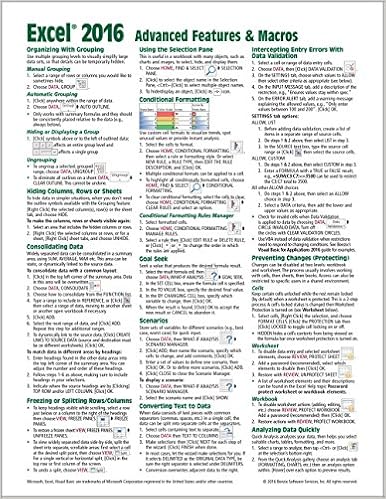
Microsoft Excel 2016 Advanced & Macros Quick Reference Guide - Windows Version (Cheat Sheet of Instructions, Tips & Shortcuts - Laminated Card), by Beezix Inc

Get Free Ebook Microsoft Excel 2016 Advanced & Macros Quick Reference Guide - Windows Version (Cheat Sheet of Instructions, Tips & Shortcuts - Laminated Card), by Beezix Inc
Why learning more publications will offer you extra prospects to be effective? You recognize, the much more you review guides, the more you will certainly obtain the unbelievable lessons as well as knowledge. Many individuals with lots of books to end up read will act different to individuals who don't like it a lot. To present you a much better thing to do everyday, Microsoft Excel 2016 Advanced & Macros Quick Reference Guide - Windows Version (Cheat Sheet Of Instructions, Tips & Shortcuts - Laminated Card), By Beezix Inc can be selected as good friend to invest the leisure time.
The advantages to take for checking out the books Microsoft Excel 2016 Advanced & Macros Quick Reference Guide - Windows Version (Cheat Sheet Of Instructions, Tips & Shortcuts - Laminated Card), By Beezix Inc are pertaining to enhance your life high quality. The life top quality will certainly not simply regarding just how much knowledge you will gain. Also you review the enjoyable or amusing publications, it will assist you to have enhancing life quality. Feeling fun will lead you to do something perfectly. Moreover, guide Microsoft Excel 2016 Advanced & Macros Quick Reference Guide - Windows Version (Cheat Sheet Of Instructions, Tips & Shortcuts - Laminated Card), By Beezix Inc will certainly offer you the driving lesson to take as an excellent need to do something. You may not be worthless when reviewing this book Microsoft Excel 2016 Advanced & Macros Quick Reference Guide - Windows Version (Cheat Sheet Of Instructions, Tips & Shortcuts - Laminated Card), By Beezix Inc
When you can offer the fact in obtaining much details from analysis, why should you ignore it? Numerous successful people likewise are success from reviewing numerous publications. From book to book ended up have actually been numerous, it's uncountable. As well as this Microsoft Excel 2016 Advanced & Macros Quick Reference Guide - Windows Version (Cheat Sheet Of Instructions, Tips & Shortcuts - Laminated Card), By Beezix Inc is the one that you need to review. Also you are starter to review, this publication will be likewise so useful to handle. After finishing reading, the lesson and message that is added can be reached conveniently. This is just one of the very best seller publication ought to be.
In fact, this is not a force for you to love this publication and also read until finish this book. We show you the excellent publication. It will be so pity if you miss it. This is not the right time for you to miss out on the Microsoft Excel 2016 Advanced & Macros Quick Reference Guide - Windows Version (Cheat Sheet Of Instructions, Tips & Shortcuts - Laminated Card), By Beezix Inc not to read. It can assist you not only fulfilling this holiday times. After holidays, you will obtain something new. Yeah, this book will really lead you to life much better. This is why; this recommended publication is much uttered for you that intend to progress always.
About the Author
Beezix has been publishing quick reference computer guides for trainers, training companies, corporations, and individuals across the US and Canada for the past 20 years. Founded by trainers, extensive industry experience made us aware of the need for a line of high-quality guides that were clear, accurate and concise. Our cards are designed for casual computer users right through to trainers and help desk staff.
Read more
Product details
Pamphlet: 2 pages
Publisher: Beezix Inc (May 23, 2016)
Language: English
ISBN-10: 1944684085
ISBN-13: 978-1944684082
Package Dimensions:
10.9 x 8.5 inches
Shipping Weight: 0.8 ounces (View shipping rates and policies)
Average Customer Review:
4.5 out of 5 stars
27 customer reviews
Amazon Best Sellers Rank:
#30,053 in Books (See Top 100 in Books)
I like having a quick cheat-sheet around. For a self taught excel user sometimes things/stuff happeneds and you don’t have the time to look through a massive volume reference book. Having a quick most used in the office/home cheat sheet is so helpful for me. It might not work for others but if helps me remember functions I haven’t done in while. You know that saying, “If you don’t use it, you will lose itâ€. Meaning you will forget how to do things if you don’t do it all the time. That’s me!
I'm relatively new to excel so this cheat sheet works so much better than trying to find something in the book the course came with. Use it over and over again. Works especially on those worksheets you only have to work on once every 3 months or so.
I am relearning Excel and its formula’s and needed a quick reference guide for the future and found it with this chart. Highly recommend this to anyone using Excel.
Not super helpful. Gives too little info and yet not anything I need.
Nice and easy to use -- well organized and easy to understand.
Excellent. It is easy to read and understand.
Very helpful examples of how to apply advanced features and macros in Excel
Very handy to have.
Microsoft Excel 2016 Advanced & Macros Quick Reference Guide - Windows Version (Cheat Sheet of Instructions, Tips & Shortcuts - Laminated Card), by Beezix Inc PDF
Microsoft Excel 2016 Advanced & Macros Quick Reference Guide - Windows Version (Cheat Sheet of Instructions, Tips & Shortcuts - Laminated Card), by Beezix Inc EPub
Microsoft Excel 2016 Advanced & Macros Quick Reference Guide - Windows Version (Cheat Sheet of Instructions, Tips & Shortcuts - Laminated Card), by Beezix Inc Doc
Microsoft Excel 2016 Advanced & Macros Quick Reference Guide - Windows Version (Cheat Sheet of Instructions, Tips & Shortcuts - Laminated Card), by Beezix Inc iBooks
Microsoft Excel 2016 Advanced & Macros Quick Reference Guide - Windows Version (Cheat Sheet of Instructions, Tips & Shortcuts - Laminated Card), by Beezix Inc rtf
Microsoft Excel 2016 Advanced & Macros Quick Reference Guide - Windows Version (Cheat Sheet of Instructions, Tips & Shortcuts - Laminated Card), by Beezix Inc Mobipocket
Microsoft Excel 2016 Advanced & Macros Quick Reference Guide - Windows Version (Cheat Sheet of Instructions, Tips & Shortcuts - Laminated Card), by Beezix Inc Kindle
Microsoft Excel 2016 Advanced & Macros Quick Reference Guide - Windows Version (Cheat Sheet of Instructions, Tips & Shortcuts - Laminated Card), by Beezix Inc PDF
Microsoft Excel 2016 Advanced & Macros Quick Reference Guide - Windows Version (Cheat Sheet of Instructions, Tips & Shortcuts - Laminated Card), by Beezix Inc PDF
Microsoft Excel 2016 Advanced & Macros Quick Reference Guide - Windows Version (Cheat Sheet of Instructions, Tips & Shortcuts - Laminated Card), by Beezix Inc PDF
Microsoft Excel 2016 Advanced & Macros Quick Reference Guide - Windows Version (Cheat Sheet of Instructions, Tips & Shortcuts - Laminated Card), by Beezix Inc PDF
Download Ebook , by Tasha Fierce
When intending to have such experience, reading a book will be likewise the guidance in you doing that act. You can start from gathering the motivation initially and also thinking of the activities. Additionally this , By Tasha Fierce can help you to boost the knowledge of just what you have actually unknowned pertaining to exactly what you will do today. Reading it may be done step by step by reviewing web page by web page. It will certainly not constantly be in the short time to finish this publication.
, by Tasha Fierce

Download Ebook , by Tasha Fierce
After coming to be effective to finish checking out a publication, have you been enough? As a book enthusiast, it will certainly not suffice to read guide. Continue and proceed! This is just what you should do to enhance as well as always develop the expertise. Bok is one that will make you feel addicted. Yet, it remains in the favorable term. Discover guides that will provide favorable enhancement for you now.
One of the sources to get in this internet collection is the , By Tasha Fierce This site with this book turns into one of the discovering centres to get the sources as well as products. Lots of books from several sources, publishers, and writers from around the globe are provided. This solution will certainly give not just the assistance books, the referrals, literature, and standard books are available to find out.
Schedule tends to be the window to globe, as what many individuals claim. But, publication will not be this excellent thing to the brand-new globe if you do not read it and also comprehend. Checking out a publication is not a pressure. It's really a need to be one of advice in life. , By Tasha Fierce is also not sort of a large excellent publication kind; every world can be made use of to suggest you to life much better. Even you have great feature of strategies, you could have to read this type of publication. Why?
You need to start caring reading. Also you will not be able to spend the book for all day, you can additionally spend couple of times in a day for times. It's not sort of strong tasks. You could take pleasure in checking out , By Tasha Fierce anywhere you truly have wish. Why? The provided soft documents of this publication will ease you in getting the meaning. Yeah, get the book here from the web link that we share.
Product details
File Size: 1761 KB
Print Length: 392 pages
Page Numbers Source ISBN: 1844676889
Publisher: Verso (July 1, 2011)
Publication Date: July 1, 2011
Sold by: Amazon Digital Services LLC
Language: English
ASIN: B005IXUDQU
Text-to-Speech:
Enabled
P.when("jQuery", "a-popover", "ready").execute(function ($, popover) {
var $ttsPopover = $('#ttsPop');
popover.create($ttsPopover, {
"closeButton": "false",
"position": "triggerBottom",
"width": "256",
"popoverLabel": "Text-to-Speech Popover",
"closeButtonLabel": "Text-to-Speech Close Popover",
"content": '
});
});
X-Ray:
Not Enabled
P.when("jQuery", "a-popover", "ready").execute(function ($, popover) {
var $xrayPopover = $('#xrayPop_116BC780578011E984F2FFA5187B928D');
popover.create($xrayPopover, {
"closeButton": "false",
"position": "triggerBottom",
"width": "256",
"popoverLabel": "X-Ray Popover ",
"closeButtonLabel": "X-Ray Close Popover",
"content": '
});
});
Word Wise: Enabled
Lending: Not Enabled
Screen Reader:
Supported
P.when("jQuery", "a-popover", "ready").execute(function ($, popover) {
var $screenReaderPopover = $('#screenReaderPopover');
popover.create($screenReaderPopover, {
"position": "triggerBottom",
"width": "500",
"content": '
"popoverLabel": "The text of this e-book can be read by popular screen readers. Descriptive text for images (known as “ALT textâ€) can be read using the Kindle for PC app if the publisher has included it. If this e-book contains other types of non-text content (for example, some charts and math equations), that content will not currently be read by screen readers.",
"closeButtonLabel": "Screen Reader Close Popover"
});
});
Enhanced Typesetting:
Enabled
P.when("jQuery", "a-popover", "ready").execute(function ($, popover) {
var $typesettingPopover = $('#typesettingPopover');
popover.create($typesettingPopover, {
"position": "triggerBottom",
"width": "256",
"content": '
"popoverLabel": "Enhanced Typesetting Popover",
"closeButtonLabel": "Enhanced Typesetting Close Popover"
});
});
Amazon Best Sellers Rank:
#248,654 Paid in Kindle Store (See Top 100 Paid in Kindle Store)
This is a piece that must have been gestating in the collective consciousness for many years. I have long been interested in the sociological foundations and implications of the punk rock movement and this book covers that terrain with enthusiasm and vigor. Well done and highly recommended!
At the age of 56 ad having lived in Greenwich Village and Ireland during the Punk era, I believe that the essence of Punk was very specific. It was an expression of the extreme frustration of lower class white (mostly) men who had little hope for their future and access to a lot of drugs and sex in a pre-AIDS world. It was also the then current form of teenage/20-something angst - a phenomenon that is as old as time. It also resulted in some great music - "I Don't Like Mondays" and "Rat Trap" being my personal favorites since I was a Boomtown Rats fan from the time they cut their first single. I was in Greenwich Village when CBGBs opened and I was at the Boomtown Rats concert in Dun Laoghaire during the first outdoor concert in Irish history. In my eyes, the lasting legacy of Punk is not a group of people who don't have a focus - it is Bob Geldof who mobilized a movement to help the world. The Occupy "movement" accomplished little of moment (I consider "Occupy" it in the past tense and am glad that we now actually have a "movement" in the old sense of the word where people march and take action instead of talking about elusive theories that have nothing to do with any life experience or practical change).Sorry for the diatribe but I become frustrated when I hear theories about history that I have actually lived through. What every 20 something generation has in common is that they know everything and don't realize that their elders actually may know something too.Enough said - carry on
This book is an insulting, condescending fantasy-driven response to those of us who lived and created the LA punk lifestyle. Traber's off-the-wall totally-out-of-touch-with-LA-punk rant is not based on any actual interviews or archival material other than ONE source.--I was shocked reading his 'essay' which is a CLASSIC! A classic? How can one man be the authority when he woefully closed his eyes to realities easily refuted by so many other sources, esp photos and fanzines which contradict most everything he states. He cherry-picked his quotes and thesis based on a ONE movie with a very specific, very narrow POV.--The way he describes the punks at the Canterbury made me nauseous. MANY of them went onto very productive, accomplished creative lives and careers. They were far from "spoiled brats." Many were abused, neglected, confused, some mentally ill and most using drugs/booze (to self-medicate) who had NOWHERE else to go. Or were exploring their lives between high school and either college, trade school, work, marriage, raising a family.--I was shocked when I first saw Penelope Spheeris' Decline. I'm in it and some of my most famous, iconic photos of X taken during her filming of that segment. Her film, although true from HER POV, didn't reflect my vast photo archive and personal experiences the previous four yrs, living and documenting the punk lifestyle, genre and scene. There's so much available refuting his feeble, wordy and obtuse essay. Read Slash Magazine and go from there! SHE had access to all the issues but chose to focus on the dark side.--Those of us who created it, starting around 1976 and by spring/summer 1977, have a vastly different take on what, why and how LA Punk developed. I am SO tired of hearing we were racists or excluded the Other. Our doors were open. Many, many Latinos/Latinas involved, many Jews, many gay young men and women. WE were the Other. he goes on and about the Other. Wassup with that? WE were the rejected ones or rejected following the path society expects from us. At least for awhile, while we explored other CREATIVE options.--Plus none of us embraced poverty. He went on and on about that. Tell me how we were supposed to make money when writing, photographing, performing and looking like we did and kept the hours we did. Plus many did work, at record stories, for bands, record companies, temp jobs and a wide variety of other jobs (some in the sex trade). He TOTALLY missed the point of living at the Canterbury. I was amazed no mention of the Masque.--He's made a whole career by projecting HIS fantasies on the scene. Shame on him. Shame on the editors who included more of this tripe. Apparently, not many of the contributors were actually involved in punk back in the day and don't know how to research real facts. Oh well, people only see what THEY want to see. URGH!
, by Tasha Fierce PDF
, by Tasha Fierce EPub
, by Tasha Fierce Doc
, by Tasha Fierce iBooks
, by Tasha Fierce rtf
, by Tasha Fierce Mobipocket
, by Tasha Fierce Kindle
, by Tasha Fierce PDF
, by Tasha Fierce PDF
, by Tasha Fierce PDF
, by Tasha Fierce PDF
Download PDF Management Information Systems
The very first factor of why picking this book is because it's supplied in soft file. It implies that you can save it not just in one gadget yet additionally bring it anywhere. Management Information Systems will showcase how deep guide will certainly provide for you. It will give you something new. Also this is just a book; the presence will really show how you take the ideas. And also now, when you really should make deal with this publication, you could begin to get it.
Management Information Systems

Download PDF Management Information Systems
Management Information Systems. Learning how to have reading habit is like discovering how to try for eating something that you truly don't desire. It will certainly need more times to assist. Additionally, it will certainly likewise little bit force to serve the food to your mouth as well as swallow it. Well, as reading a book Management Information Systems, in some cases, if you ought to read something for your new jobs, you will feel so lightheaded of it. Also it is a publication like Management Information Systems; it will certainly make you really feel so bad.
Guide with that Management Information Systems features the some ideas the motivations can be taken for you that plan such a brand-new service. When you have no idea to intend just what to do, this book will aid you. It happens when you depend read it perfectly and also get it extremely. Are you interested to review it? Let's take few mins to handle this book and after that take it as checking out material.
Management Information Systems that we recommend in this website has lot with the presentation of making better person. In this location, you could see just how the existence of this publication very crucial. You could take far better publication to accompany you. When you require the book, you can take it conveniently. This publication will reveal you a new experience to understand even more concerning the future. Even the book is extremely wonderful; you will not really feel tough to value the material
Delivering good book for the readers is kind of enjoyment for us. This is why, guides that we presented constantly guides with unbelievable factors. You can take it in the kind of soft documents. So, you could check out Management Information Systems quickly from some gadget to make best use of the modern technology use. When you have actually decided to earn this publication as one of referred publication, you could offer some finest for not only your life yet likewise your individuals around.
About the Author
James A. O'Brien completed his undergraduate studies at the University of Hawaii and Gonzaga University and earned an MS and PhD in Business Administration from the University of Oregon. He has been professor and coordinator of the CIS area at Northern Arizona University, professor of Finance and Management Information Systems and chairman of the Department of Management at Eastern Washington University, and a visiting professor at the University of Alberta, the University of Hawaii, and Central Washington University. Jim's research interests lie in developing and testing basic conceptual frameworks used in information systems development and management. He has written eight books, including several that have been published in multiple editions. He has also contributed to the field of information systems through the publication of many articles in business and academic journals, as well as through his participation in academic and industry associations in the field of information systems.
Read more
Product details
Hardcover: 624 pages
Publisher: McGraw-Hill/Irwin; 7 edition (January 14, 2005)
Language: English
ISBN-10: 007293588X
ISBN-13: 978-0072935882
Product Dimensions:
8 x 1 x 11 inches
Shipping Weight: 3.4 pounds
Average Customer Review:
3.9 out of 5 stars
263 customer reviews
Amazon Best Sellers Rank:
#2,905,346 in Books (See Top 100 in Books)
The paperback version of this is the "Global Edition" and it has many changes from the hardcover/US edition that render it unusable for our class. (Mainly, most of the examples and case studies are changed from profiling US businesses to international ones. Which is fine on its own, and actually some of them are more interesting, but it's kind of a problem when the quiz questions are about Kroger and you read about the British Rugby League.)It actually says right on the back, "If you purchased this book within the United States or Canada, you should be aware that it has been imported without the approval of the publisher or author." So this book should NOT be for sale on Amazon to US customers.
If you look in the top right-hand comer there is a red triangle, with a warning, this is not legible, however.Once I got the book I could read it.It does NOT have the same content as the hard cover, and was not usable for my class, as the case studies were different; instructor gave assignments for original case studies, that were on different pages, and some have just been replaced with case studies for the Indian continent.
I think of myself as an technology savvy individual, so when my computer science class had this book I bought it in the Kindle edition. It was still $165.00 which seemed very steep, but I enjoy reading on my iPad via the Kindle app, so thought his would be a good fit.However it really should be described as a PDF of the textbook, not a Kindle ebook. The text size cannot be changed, since it is essentially just a picture of the page. That means that on a retina iPad it is still difficult to read the page without zooming in, and eye strain and frustration sets in quickly.The only positive has been that you can search the text, however even that works fairly slowly due to the size of the file.I would recommend you buy the paper version of the book until this publisher figures out how to implement an e-textbook correctly. Or make it a heck of a lot cheaper in the Kindle version.
This is a really poor book. I wasted time reading it for the MBA course and feel learned little.1. Too wordy. Knowledge in book can be way more succinct.2. Many information is already common sense and the other information mostly unhelpful.3. Mostly incoherent definitions are provided. No coherent idea delivered.I wish course professors find another book. If not for the course, I wouldn't bother reading it.
This review is primarily about the ebook version of this textbook.The book's content is good so far, so I have given it two stars. Nevertheless, the ebook version is awful, with the only positives being the result of the Kindle software mitigating some of the book's failures slightly. This version manages to give up most of the benefits of a physical book, with Kindle software providing the ability for markup and notes. Most of the benefits of having an ebook are restricted by the publisher. You are restricted to two installed copies, though admittedly the ebook is so useless that two copies are probably sufficient. If you thought about reading on any device smaller than a full-size (10 inch display) tablet, you will most likely be disappointed. The only situation where this ebook is reasonable to read is on a computer monitor with a decent display size. The book is locked into a flat-image display of each page, much like looking at a PDF file from a scanner, except lacking the scrolling fluidity of PDF documents.With a large tablet, you can orient the tablet sideways to zoom the image in sufficiently to be readable (but lacking the crispness of typical kindle books) and scroll down as you read. There is no page-turning in a useful sense, and the book likes to jump to the next page as soon as you've scrolled down too far, often requiring you to turn the page back, and re-zoom in. Each page will require you to zoom, unless you are using the Kindle PC software.I've read about 500 Kindle eBooks, including textbooks, starting back when the first Kindle ereader was released. This is the worst I've experienced that wasn't self-published.
This book covered good relevant topics of businesses information systems and technology. I used it during Term One, Fall 2016 for my masters degree. My biggest gripe is that the current edition is very outdated. There are countless examples and references of businesses that were startups, listed as successful when the book was written in 2009. However, several examples were touted as great IS examples but had failed not soon after the book was written.There are lots of old pictures too that need updating. One example is a server room with ancient IBM server stacks that look circa early 1990's.The most annoying part of reading this book was the constant reference to the first generation iPhone. The book kept touting that the iPhone and other smart phones will change how humans will conduct business, e-commerce, etc. For me to get through the entire book I had to look past the old info and remind myself that technology advances fast. While reading the book, I would put the iPhone 7 in my minds eye and insert iPhone 7 into the text whenever I would read iPhone. That is how outdated the book is. There are countless references and sources listed throughout the book using early 2000's charts, graphs, and mid to late 2000's as being the most recent.This book is still valuable as it teaches the basics of data storage and data systems which is the foundation that todays IS still are based on.
Management Information Systems PDF
Management Information Systems EPub
Management Information Systems Doc
Management Information Systems iBooks
Management Information Systems rtf
Management Information Systems Mobipocket
Management Information Systems Kindle
Management Information Systems PDF
Management Information Systems PDF
Management Information Systems PDF
Management Information Systems PDF
Download Kubernetes: Up and Running: Dive into the Future of Infrastructure
This is among your much-loved publications, isn't it? That holds true. If this is just one of them, you can begin by checking out web page by page for this publication. The factors might not be so challenging. We offer you a great publication that will certainly not just influence you but likewise show you the true life. When getting this publication to review, it will be so different when you read others. This is a brand-new coming book that makes this world so shacked. For the sake of your life, you can obtain numerous alternatives and benefits develop this Kubernetes: Up And Running: Dive Into The Future Of Infrastructure
Kubernetes: Up and Running: Dive into the Future of Infrastructure

Download Kubernetes: Up and Running: Dive into the Future of Infrastructure
Discover tons of guide catalogues in this website as the choice of you visiting this web page. You could additionally join to the internet site book collection that will reveal you numerous books from any type of types. Literary works, science, politics, and also a lot more catalogues exist to provide you the very best publication to find. The book that really makes you feels satisfied. Or that's the book that will save you from your task target date.
Feel tough to get this best seller book? Why? We presume that best seller publication will constantly run out promptly. So, it's not to strange when you will certainly feel difficult to get it in the book store, or you should bespeak Kubernetes: Up And Running: Dive Into The Future Of Infrastructure when you require it. Have adequate time? Not everybody can wait for log minute to obtain the book. To conquer this issue, we are below to provide you service. It is not actually difficult for us. We absolutely help you by serving the checklists of the brand-new best seller publications on the planet.
Currently, you might understand well that this book is mostly advised not only for the visitors that enjoy this topic. This is additionally advertised for all individuals and public kind society. It will certainly not restrict you to read or not the book. However, when you have started or started to review DDD, you will know why precisely guide will certainly offer you al positive things.
By beginning to read this book immediately, you can easily discover properly to earn better high qualities. Use your free time to read this book; even by pages you can take much more lessons and also inspirations. It will certainly not limit you in some events. It will release you to always be with this publication every time you will review it. Kubernetes: Up And Running: Dive Into The Future Of Infrastructure is currently offered below as well as be the initial to get it now.
About the Author
Kelsey Hightower has worn every hat possible throughout his career in tech, and enjoys leadership roles focused on making things happen and shipping software. Kelsey is a strong open source advocate focused on building simple tools that make people smile. When he is not slinging Go code, you can catch him giving technical workshops covering everything from programming to system administration.Brendan Burns is a Partner Architect in Microsoft Azure, working on Azure Container Service and Azure Resource Manager. Prior to Microsoft he worked at Google in the Google Cloud Platform, where he co-founded the Kubernetes project and helped build APIs like Deployment Manager and Cloud DNS. Before working on cloud, he worked on Google's web-search infrastructure, with a focus on low-latency indexing. He has a PhD in Computer Science from the University of Massachusetts Amherst with a specialty in Robotics. He lives in Seattle with his wife Robin Sanders, their two children and a cat Mrs. Paws, who rules over their household with an iron paw.Joe Beda is that CTO of Heptio, a startup focused on bringing Kubernetes to everyone. During his previous 10 year career at Google Joe co-founded Kuberntes and started Google Compute Engine, Google's cloud VM service. Prior to doing Cloud stuff, Joe helped build Google Talk and, while at Microsoft, worked on IE during the browser wars (Don't hate him! It makes for good discussions over drinks). He lives in Seattle with his physician wife, Rachel, 2 kids and Willie the wonder dog.
Read more
Product details
Paperback: 202 pages
Publisher: O'Reilly Media; 1 edition (September 7, 2017)
Language: English
ISBN-10: 9781491935675
ISBN-13: 978-1491935675
ASIN: 1491935677
Product Dimensions:
7 x 0.4 x 9.2 inches
Shipping Weight: 12.6 ounces (View shipping rates and policies)
Average Customer Review:
3.6 out of 5 stars
26 customer reviews
Amazon Best Sellers Rank:
#33,153 in Books (See Top 100 in Books)
Before purchasing, keep in mind what this book is versus what it is not. If it is judged for what it is not, you will find it to be lacking. If you look at it for what it is, you should find it valuable.This book is a good introduction to Kubernetes, going through an overview of the operations of the platform and a high level overview of what it takes to run it. While reading it, I found myself gaining a much greater comfort level starting to dig into the platform, creating pods, replica sets, etc.This book does not go in depth in any topic. For instance, you will learn how to deploy a ReplicaSet, associate it with configurations and secrets. but if something goes wrong, there is no detail on how to troubleshoot. It will not walk you through the installation or initial configuration of a Kubernetes cluster. So if you're looking to spin up a few VM's in VirtualBox (or a tool of your choice), you'll need to look elsewhere.To me, this book is strictly around the operation of Kubernetes. If you're being introduced to a previously working environment, this is a great book. If you're looking to spin up a cluster and run that, use this book to supplement however you're installing. If you're looking for something deep and "crunchy," this book is not for you.For me, personally, I'd installed a cluster using online resources and used this book to gain greater knowledge of how to run the environment. It delivered what I wanted and now I'm looking for the proverbial next step.
I was completely disappointed by this book.First, the content quality is poor because one line is split into several.Second, the content structure is messed. The author is not providing overall information, just describes tiny parts of the system without mentioning tricky parts.The best decision if you consider adding this book to your collection, just read the docs. Official documentation is well organised and easy to understand.
Good but mostly for beginners or users. For developers, it's a good overview. Once you understand it all, you really should go to the kubernetes.io website to learn more details. This book is more a how to use kubernetes not how it works. It also doesn't touch a point of headache for many users, which is how to deploy kubernetes in the first place. It assumes you have a cluster up and running and proceeds to show you how to deploy containers, pods, and services, etc. They use minikube for their examples and assume you can figure out how to deploy a more complex cluster on your own.
There are so many errors in the code snippets and text that a lot of cycles were wasted on wild goose chases when something went wrong. I spent a lot of time rereading and trying to figure out what I miskeyed, only to later discover that the book was incorrect. Frustrating! Take chapter 14, "Deploying Real-World Applications," for example: 2 of the 3 applications did not work as written. They only worked after hunting for (sometimes extensive) corrections on-line.I also found many of the explanations and definitions lacking. The book also needed a lot more diagrams to clearly illustrate the concepts and how the Kubernetes components work together.The tutorial on the Kubernetes website is superior. It has more and better diagrams for those who find visual aids helpful, the text is clearly written, and the examples work.
Following examples in that book wont be helpful as authors of the book assumes that their experience with Raspberry will like theirs. Much better to go to kubernetes site and learn it from there. Lots of wrong or dated statement.I did not claim a refund, but i do not recommend it at ll!
It's been a hell of long time since I bought a technical book & couldn't put it down :-) Very well written & correct level of technical detail - I can look up the specific syntax, but this gives me everything I need to get going, quickly. I've been hearing a lot about kubernetes and this helped give all the context to understand what it's really all about!
This book is a helpful guide to someone new to Kubernetes. The shortcomings become clear when you try some of the hands-on sections yourself. Appendix A is supposed to guide the reader through creating a Kubernetes cluster in Raspberry Pi devices. As a rough guide it's okay...except that there were sections where the text said "do x" and had a few lines of example text...and it turned out to be hours of work to sort out how to get that done. Overall the book is a good starter guide, as long as the reader expects there will be gaps and omissions.
The book is a must read for any developer working on an project in which the containers are managed by Kubernetes. Although I recommend reading the official documentation afterwards, this book certainly offers a friendlier introduction and is a great resource for drilling the fundamentals.
Kubernetes: Up and Running: Dive into the Future of Infrastructure PDF
Kubernetes: Up and Running: Dive into the Future of Infrastructure EPub
Kubernetes: Up and Running: Dive into the Future of Infrastructure Doc
Kubernetes: Up and Running: Dive into the Future of Infrastructure iBooks
Kubernetes: Up and Running: Dive into the Future of Infrastructure rtf
Kubernetes: Up and Running: Dive into the Future of Infrastructure Mobipocket
Kubernetes: Up and Running: Dive into the Future of Infrastructure Kindle
Kubernetes: Up and Running: Dive into the Future of Infrastructure PDF
Kubernetes: Up and Running: Dive into the Future of Infrastructure PDF
Kubernetes: Up and Running: Dive into the Future of Infrastructure PDF
Kubernetes: Up and Running: Dive into the Future of Infrastructure PDF
PDF Download Kaplan GRE Exam Subject Test: Biology 2009-2010 Edition (Kaplan Gre Biology)
This is some of the advantages to take when being the participant and also get guide Kaplan GRE Exam Subject Test: Biology 2009-2010 Edition (Kaplan Gre Biology) right here. Still ask exactly what's various of the other website? We offer the hundreds titles that are produced by advised authors and also publishers, all over the world. The connect to get and download and install Kaplan GRE Exam Subject Test: Biology 2009-2010 Edition (Kaplan Gre Biology) is likewise really easy. You could not discover the challenging website that order to do even more. So, the way for you to obtain this Kaplan GRE Exam Subject Test: Biology 2009-2010 Edition (Kaplan Gre Biology) will be so very easy, will not you?
Kaplan GRE Exam Subject Test: Biology 2009-2010 Edition (Kaplan Gre Biology)

PDF Download Kaplan GRE Exam Subject Test: Biology 2009-2010 Edition (Kaplan Gre Biology)
If you are still back to back to locate the ideal publication to check out, we have supplied a terrific publication as candidates. Kaplan GRE Exam Subject Test: Biology 2009-2010 Edition (Kaplan Gre Biology) as one of the referred publications in this post can be appreciated currently. It is not just concerning the title that is really fascinating and also brings in individuals to come reading it. As well as why we provide this book to you is that it will be your buddy along your downtime.
Occasionally, checking out Kaplan GRE Exam Subject Test: Biology 2009-2010 Edition (Kaplan Gre Biology) is quite boring and it will take long time starting from getting guide and also start reading. However, in contemporary era, you could take the creating modern technology by utilizing the internet. By internet, you could see this web page as well as begin to look for the book Kaplan GRE Exam Subject Test: Biology 2009-2010 Edition (Kaplan Gre Biology) that is needed. Wondering this Kaplan GRE Exam Subject Test: Biology 2009-2010 Edition (Kaplan Gre Biology) is the one that you require, you can choose downloading. Have you comprehended how to get it?
In this instance, spending even more time to check out the Kaplan GRE Exam Subject Test: Biology 2009-2010 Edition (Kaplan Gre Biology) page by page can hold the ideal function of analysis. This is among the methods for you that truly wish to take the basic reading as the referred activity. You could get guide to offer also for your buddies as the book to refer. Again, this subject of the book will provide you matched lesson to the topic.
This is just what you need to do in needing what exactly we offer. This is not nonsense, this is something to produce better principle. Generally, publication will not constantly influent someone to act and also think much better. It will certainly rely on exactly how the people will certainly stare and also think of the lesson given by the book. However, when you have actually handled checking out guide arranged, the Kaplan GRE Exam Subject Test: Biology 2009-2010 Edition (Kaplan Gre Biology) will certainly have despite to require.
Product details
Series: Kaplan Gre Biology
Paperback: 456 pages
Publisher: Kaplan Publishing; 4 edition (August 5, 2008)
Language: English
ISBN-10: 141955218X
ISBN-13: 978-1419552182
Product Dimensions:
8.4 x 0.9 x 10.9 inches
Shipping Weight: 2.2 pounds
Average Customer Review:
3.1 out of 5 stars
10 customer reviews
Amazon Best Sellers Rank:
#1,189,775 in Books (See Top 100 in Books)
The book is outdated , no longer covers the test content as of 2017. There is nothing wrong with book - it's 8 years old -just beware it will not suffice to pass exam in 2018
I bought this book to study for the 2009 GRE, which I just took. The book is very light on detail, and very sloppy throughout -- you probably saw better diagrams and explanations on the home-made handouts you got from any of your professors. It certainly isn't up to the standard of a good textbook. All the way through, there are inaccuracies and errors.However, it does provide a crude sort of overview of what topics are on the test. It's slightly more useful than the official list of topics from ETS, in that you think you might know about a particular topic, but when you read the review section you'll find that you've never heard of certain subtopics. My advice would be to skim it, reviewing the stuff you know, and noting which areas you need to learn more about. DON'T try to learn new material from this review guide. Instead, go pick up a GOOD college intro bio textbook, and learn as much as you can from that over a few weeks. Or if you're really ambitious, and have several months, go to the intermediate textbooks.The single (!) practice test is also kind of infuriating -- full of sloppy questions and outright errors. And it doesn't give you any feedback about how well you do -- you might freak out after only scoring 75% on the practice test, but if you then take the official practice test from ETS, you'll find that a 75% actually translates to a damn good score -- somewhere around 90th percentile.
This book provides a decent look at most of the areas that are emphasized on the Biology Subject Test. However, I found inaccuracies in some very basic concepts, so double-check what it tells you with other sources. The book is also poorly written both in terms of grammar/syntax and explaining concepts clearly. Other reviewers recommend purchasing the Campbell Biology text instead of this guide, and that is a good idea if you can determine which concepts will be useful for the GRE and how many details you will be expected to know. Campbell is so detailed that it would be easy to become overwhelmed and to spend too much time studying unnecessary concepts or facts. I studied using both books and found that I could determine what was important with the Kaplan Guide and then learn those topics properly with Campbell.
A bit better than the PR guide, at least the paper is of higher quality. More topics are covered in more details, but there are still things missing. And beware, some of the details in this book may not be correct. The best thing to prepare for your GRE biology is to use this book to determine what materials you need to know for the exam, and study the equivalent topics in your Campbell (or any intro. Biology textbook)
Well crafted.
I brought this book to study for my Biology exit exam. I was helpful in certain areas but it is missing a lot of information in the subject of biology
I used this book when preparing for the subject test. Having taken the test, I feel like this book is almost as helpful as not studying at all. It's just kind of useless in terms of relevant information. I wouldn't recommend it. Find some other study material.
I noticed 3 mistakes within the first few pages of chapter one. If the author doesn't know an ester linkage should have a double bond to oxygen, doesn't know that the chemical formula for an unsaturated fatty acid is not the same as for a saturated fatty acid, and thinks that carbon can have 5 bonds, then I don't feel comfortable using this book as a study guide for more advanced topics. I wouldn't buy this book.
Kaplan GRE Exam Subject Test: Biology 2009-2010 Edition (Kaplan Gre Biology) PDF
Kaplan GRE Exam Subject Test: Biology 2009-2010 Edition (Kaplan Gre Biology) EPub
Kaplan GRE Exam Subject Test: Biology 2009-2010 Edition (Kaplan Gre Biology) Doc
Kaplan GRE Exam Subject Test: Biology 2009-2010 Edition (Kaplan Gre Biology) iBooks
Kaplan GRE Exam Subject Test: Biology 2009-2010 Edition (Kaplan Gre Biology) rtf
Kaplan GRE Exam Subject Test: Biology 2009-2010 Edition (Kaplan Gre Biology) Mobipocket
Kaplan GRE Exam Subject Test: Biology 2009-2010 Edition (Kaplan Gre Biology) Kindle
